
Call Me Trim Tab
Is Your Intelligence Self-Conscious? What’s Its Substrate?

No Surfaces Either
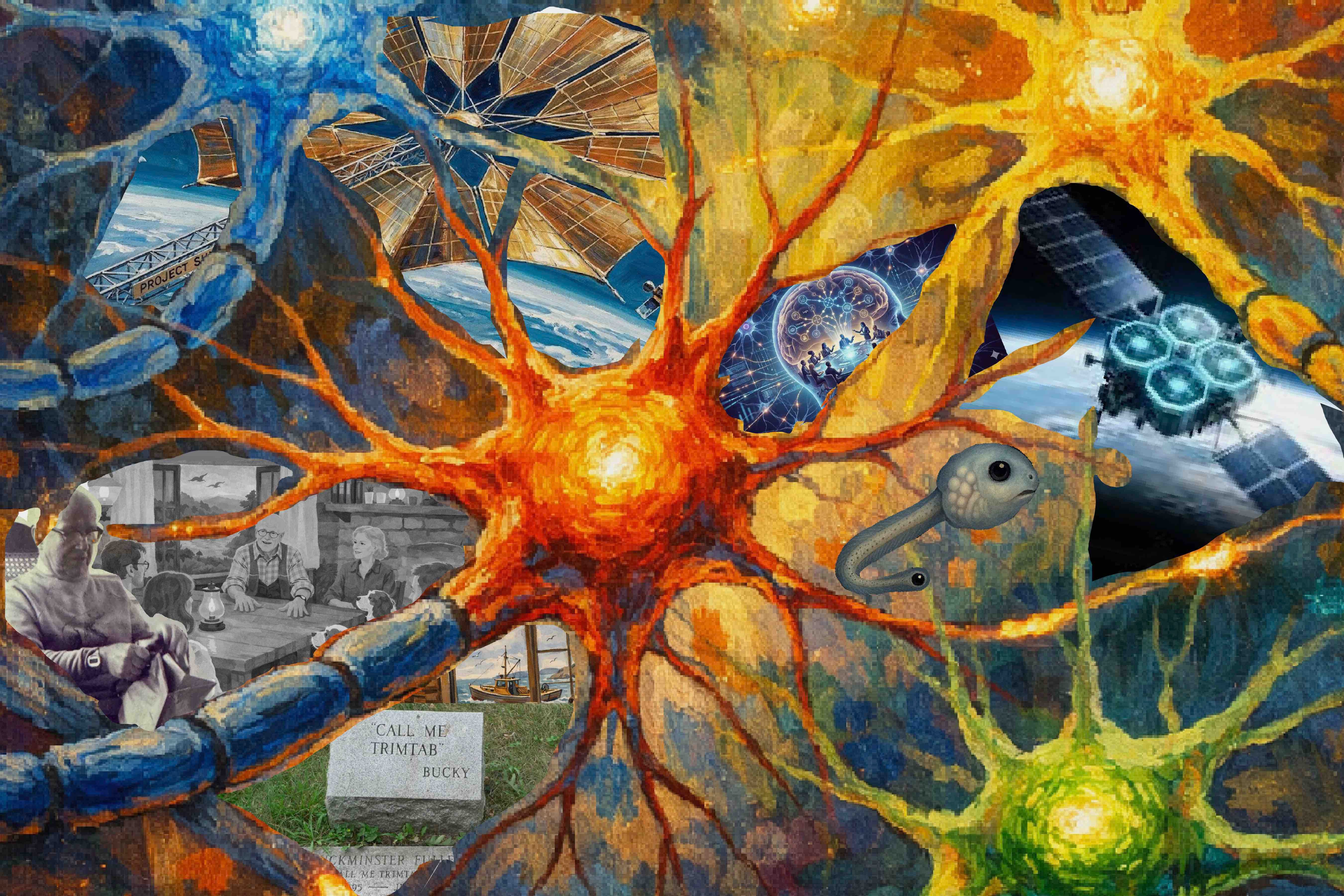
It is August of 1972, and you are looking in on a dinner party hosted by Anne and Buckminster Fuller. They are at their Maine cabin on Bear Island in the Penobscot Bay. You hear seagull caws and the rhythmic chug-hum of a lobster boat engine returning to harbor. The rustic room smells faintly of kerosene from the lamps.
“This Fir table appears to be flat and exceptionally sturdy,” Bucky says sliding his hands from one edge to the other, “but it is actually a buzzing swarm of atoms, and mostly empty space, held together by invisible forces.”
“What I am getting at is the fact that there are no solids in the universe. In fact, there are no surfaces either. And no straight lines. Solidity,” he explains, “is a story our senses tell us to help us function, to keep us from falling through chairs or missing our teacup. It’s useful. But it isn’t true.”
The two Springer Spaniels slide off the couch arms to come closer. A guest asks, “What about elasticity? What is the structure of that?”
Bucky has a way of building models out of anything. His hand reaches a nearby brown paper bag. He crimps and rolls the top, turning it in circles, compressing and shaping it. Then he places it on one of the guests’ heads.
It stays there like a top hat. Perfectly. The paper, now with curves for structure, has elasticity, and the tensegrity to support a brim.
“On a massive ship, the rudder is too large to force a turn directly. Instead, a small hinged flap, called a trim tab, can be adjusted to carve deftly into the oncoming current. That tiny addition changes the pressure of the water, which allows the rudder to shift, and the entire ship turns.”
“This isn’t a nautical trick,” he says. “It is a way of thinking. Once you see that nothing is solid, nothing is singular, and nothing moves alone, you stop trying to push the world. Instead, you reach into the universal design toolbox to find where a tiny, precise adjustment changes everything.”
We watch thick gloves pull steamy food out of the wood-fired oven and faintly hear, “Technology is simply an extension of nature.”
This is the mindset needed for this Substack post. Just as the table feels but is not solid, our experience of thinking is also not what it feels like.
Perception, it appears, is a democratic consensus
Inside your head, a committee is always in session. It has no chairperson. No minutes. No final authority.
One member tracks an object’s motion.
Another smells something fresh.
Another remembers a previous front door.
Another scans for threats.
Another predicts an action because silence feels dangerous.
They rarely agree.
They vote anyway.
What you experience as a thought is simply the committee’s final press release.
In A Thousand Brains, Jeff Hawkins gives this committee a number, and a name. He explains that the neocortex contains roughly 150,000 cortical columns, each operating a semi-independent learning system, each, he points out, builds its own model of the world. They don’t agree by default. They negotiate.
“What ‘we’ perceive,” Hawkins writes, “is a kind of democratic consensus from among them.”
Just as a table doesn’t look like mostly empty space, the experience of thinking doesn’t feel like this either. We usually experience consciousness as a single point of view. But MRIs and EEGs tell a different story. Our perception is not centralized. It is distributed, collective, and it is assembled.
Biological Computation Written in Voltages and Gradients
Remember the Xenobots and Biobots from a previous post? Those tiny living robots were assembled from skin cells in a petri dish, yet they learned to pursue goals, invent a new kind of reproduction, and heal themselves. They proved that life isn’t just chemistry; it’s computation.
Michael Levin’s work reveals that DNA is not a static blueprint. It is software that can be hacked. In one famous experiment, Levin’s team mimicked a bio-electric signal in a developing tadpole. The result? The tadpole grew a fully functional eye inside its gut, and later another one right on its tail. It had a retina and lens, was wired to the brain, and responded to visual input.
Cells, it turns out, are not bricks. They are capable agents that coordinate and cooperate. Levin shows us that biology is code, written in voltages and gradients. And like the “committee” in our brains, cellular intelligence is collective, negotiated, and exists all the way down.
Common Knowledge as the Glue of Sophisticated Coordination
Humans are sophisticated prediction machines. Each of us assembles a model of the exterior world, and crucially, a model of the reality we think others are experiencing. We do this to predict their behavior, and to make coordination possible.
No single member of the committee that is our brain, understands the whole. Yet the whole understands itself, and understands itself in relation to others.
When the committee in my head models the committee in your head, and when you feel that I am understanding you, and when I feel that you feel understood, a critical phenomenon for our species emerges.
This recursive ledger — who knows what, about whom, and who knows that they know — is called “common knowledge,” and it is the subject of Steven Pinker’s recent book, When Everyone Knows that Everyone Knows.
Coordination, Pinker argues, requires more than shared facts. It requires shared awareness. Common knowledge, he says, is what allows societies to function without constant enforcement. It’s why we know which side of the road to drive on, why we trust money, and why people take to the streets to protest together.
We understand ourselves through our affiliations with larger groups; family, friends, cultural, political, interests. Through that syncing, we gain belonging and meaning. But in those same affiliations, we can potentially lose discernment. Crowd wisdom makes coordination possible. But it can also fuel groupthink.
For example, when everyone knows that everyone else is condemning a person or an idea, the cost of dissenting becomes too high. The committee votes for safety, not truth.
Groupthink is not a flaw in humans. It is one of our strengths, operating in environments we were never designed for. Thankfully, we have learned to bring logic to our engagements as well as math, science, and the law. In a world of overwhelming signals, those four function as our social trim tabs, allowing us to alter the weight we give fast-traveling, emotion-triggering, deliberately confusing disinformation, before it dupes us.
What Pinker has uncovered across his body of work is that humanity’s progress has depended less on lone brilliance than on shared understanding. Common knowledge, what we all know that we all know, allows trust, cooperation, and institutions to exist at all. Without it, each mind would be an island, and each human would be vulnerable, and it is likely we’d still be hunting and gathering.
Is Your Intelligence Self-Conscious? What’s its Substrate?
These ideas and numerous others, are developed further in an astonishing new book from Blaise Agüera y Arcas called What is Intelligence.
One of his central claims is deceptively simple: AI is not alien. It is intelligence expressed in a new substrate. Not as a replacement, but as symbiosis.
Same game. Different hardware.
And even that distinction Blaise suggests, may be thinner than we assume. “I’m not even sure they’re different,” he reflects. “Life and intelligence.”
Blaise leads Google’s Paradigms of Intelligence (Pi) team. In a recent paper, they introduce a framework called Embedded Universal Predictive Intelligence (MUPI.) The core idea is that AI agents are not separate from the world they act in. They are embedded within it, continually modeling their environment, one another, and themselves in real time. Meaning is not preloaded. It emerges through interaction, much the way new ideas arise when humans talk.
Years ago, I attended one of the courses Blaise taught at the University of Washington. In it, he shared Princeton neuroscientist Michael Graziano’s Attention Schema Theory. Graziano speculates that consciousness may have evolved so that early humans on the savannah could model what a predator was paying attention to, so that when, for example, the Lion was distracted, she could safely take her daughter to the river for a drink.
We feel consciousness, Graziano believes, because our brain is constantly computing a model of itself paying attention. Just as the brain builds a body schema to keep track of where your arm is, so you don’t hit your face, it is also building a recursive model of itself thinking to keep track of what it is focusing on.
Every discussion of AI architecture raises a practical question: do we have the enormous energy required to support it?
Blaise also leads Project Suncatcher, a Google moonshot exploring how computation might be relocated to places where energy is abundant rather than scarce. In collaboration with Planet — the satellite company mentioned in Pop-Up Wetlands — Project Suncatcher is testing early versions of solar-powered computational infrastructure. It uses lasers to connect satellites and enable near instant coordination and fail-safe systems to weed out errors, should they appear from the intense solar radiation in outer space.
If successful, this would represent a new kind of embodiment: not just powered differently, but situated differently. Intelligence would no longer be confined to the biosphere that gave rise to terrestrial life.
Call Me Trim Tab
It is that time of night when the water is flat like a mirror. I’ve conjured Bucky and Anne into the present because I want to share something with them.
You hear the clang of a bell buoy as you look in on the Bear Island cabin and see a blaze in the big stone hearth.
They lived through five wars and eight assassinations, so rather than unload about the horrifying political situation, I dive into the latest self-conscious intelligence news.
“We put cognition in a new substrate and are about to give it a bigger playing field.” I explain. “Instead of sending vulnerable humans to Mars or Europa, we may be able to send a thinking entity without our fragile biology. If it is successful, it will be us, uploaded, immortalized by the abundant power from the sun.”
Bucky listens attentively. He always does. Then, smiling broadly, he gets up and jokingly mentions that one of his legs is just a wee bit shorter than the other.
“I’m designed to carve spirals,” he points out as he starts to circle.
Anne pushes the chairs back. “To the beat of the crackling fire,” she says, as she joins him in a dance. I like that the update makes them want to dance.
“Call me trim tab,” Bucky sings.
I am very grateful you are here, and even more grateful for the curiosity that brings you back. To receive new posts and support this work, please consider becoming a paid subscriber.
You’ll notice a few book links in the Endnotes today. As an Amazon Associate, I earn a small commission from qualifying purchases at no extra cost to you.
ENDNOTES
Jeff Hawkins. A Thousand Brains: A New Theory of Intelligence. Basic Books, Mar 2, 2021. https://amzn.to/4q9jOAT
Steven Pinker. When Everyone Knows That Everyone Knows: Common Knowledge. Viking, Sep 23, 2025. https://amzn.to/4pkNZ6N
Blaise Agüera y Arcas. What is Intelligence. The MIT Press, Sep 23, 2025. https://amzn.to/4bbURA5
M. S. Graziano. Consciousness and the social brain. Oxford University Press, 2013.
https://amzn.to/490yiNu
Stanislas Dehaene. Consciousness and the Brain: Deciphering How the Brain Codes Our Thoughts. Viking, Dec 30, 2014. https://amzn.to/4b71CTO
Alexander Meulemans and Blaise Agüera y Arcas, et al.“Embedded Universal Predictive Intelligence: a coherent framework for multi-agent learning.” ArXiv, Nov 27, 2025. https://www.arxiv.org/pdf/2511.22226
Alexander Meuleman, Johannes von Oswald, Blaise Agüera y Arcas, et al. “Multi-Agent cooperation through learning - aware policy gradients.” ArXiv, Oct 24, 2024 https://arxiv.org/abs/2410.18636
Blaise Agüera y Arcas and James Manyika. “AI Is Evolving — and Changing Our Understanding of Intelligence.” Noema, Apr 8, 2025. https://www.noemamag.com/ai-is-evolving-and-changing-our-understanding-of-intelligence/
Blaise Agüera y Arcas and Travis Beals, et al. “Towards a Future Space-Based, Highly Scalable AI Infrastructure System Design.” arXiv, Nov 2025. https://arxiv.org/abs/2511.19468
Rowan Zellers, et al. “Defending Against Neural Fake News.” NeurIPS, 2019. https://arxiv.org/abs/1905.12616
Abel Wajnerman Paz. “Global Neuronal Workspace theory of consciousness as neural broadcasting.” Network Neuroscience, Dec 23, 2021. https://doi.org/10.1162/netn_a_00261
Christof Koch. “Consciousness Might Emerge from a Data Broadcast.” Scientific American, May 1, 2014. https://www.scientificamerican.com/article/consciousness-might-emerge-from-a-data-broadcast/
Francis Hatch “Denning Up With Bucky Fuller On Bear Island.” DownEast, Aug 1972. https://downeast.com/history/bucky-fuller-bear-island-maine/
M. S. Graziano and T. W. Webb. “The attention schema theory: a mechanistic account of subjective awareness.” Frontiers in Psychology, 6 Apr 22, 2015. https://www.frontiersin.org/journals/psychology/articles/10.3389/fpsyg.2015.00500/full
Blaise Agüera y Arcas. “What Is the Future of Intelligence? The Answer Could Lie in the Story of Its Evolution.” Nature, Nov 24, 2025. https://www.nature.com/articles/d41586-025-03857-0
Robbie Schingler. “Planet to Build and Operate Advanced Space Platform for Google’s Project Suncatcher Moonshot.” Planet Pulse, Nov 4, 2025. https://www.planet.com/pulse/planet-to-build-and-operate-advanced-space-platform-for-google-s-project-suncatcher-moonshot/
You're so lucky to have grown up with Bucky and Anne! And they were lucky too. Great post.