
Crackle with Communication
Pollination, Propagation, and Navigation

We could discuss how the same justices that granted President Trump broad immunity have now ruled that he needs to work with Congress. Or we could discuss Palestinian-led rebuilding, and the hard problem of disarming Hamas. Or we could move our attention to the ways flora and fauna absolutely crackle with communication.
Listening In on a Garden
Imagine walking into a sound studio and finding a row of microphones aimed at tomato and tobacco plants, each listening for tiny ultrasonic pops. Off to one side, an aging computer displays wavy lines like a hospital heart monitor, but what it is tracking is a flower’s crackling bioelectric missives.
You are in biologist Lilach Hadany’s lab, where a plant’s sensory world, its umwelt, is being uncovered. Umwelt, as in, the portion of reality an organism can perceive and respond to.
We cannot hear or feel these signals unaided, but with bioacoustics and electrophysiology we can begin to reveal what a plant is experiencing and how it physically responds.
Lilach Hadany believes that when a plant is cut, infected, or becomes parched, it emits ultrasonic snaps far above human hearing. A thirsty tomato might “speak” 35 times in an hour; a healthy one is nearly silent. Insects and nearby plants respond. In lab studies, plants that detect stress cues from their neighbors adjust their physiology, prime their chemical defenses, and close the tiny pores on their leaves — stomata — to conserve moisture.
The communication goes both ways. When evening primrose flowers “hear” a bee-like buzz, they boost nectar production by roughly 20 percent to attract the pollinator.
Bees contribute to this charged exchange as well. They naturally carry a positive charge and it is amplified by the friction of rapidly beating wings. Whereas flowers, grounded to the earth, hold a negative charge. A bee settles onto the velvet landing pad of a zinnia. Its wings slow and it lowers its head. The flower’s musk rises. The bee’s charge snaps the grains of pollen onto its fur; yellow dust clings tightly to its legs.
The key here is that, after its sip of nectar, the bee alters the flower’s electrical field before it takes flight. Professor Daniel Robert and his colleagues at the University of Bristol believe this change in charge serves as a signpost to other bees: it tells them to move along, this blossom has just been visited.
Efficiency matters to their survival and they matter to ours as roughly one out of every three bites of food we eat relies on pollination.
By tracking multiple data streams, the Bristol team revealed the complexity of a bee’s umwelt. It includes electrical fields detected through fine hairs on their bodies, ultraviolet landing patterns painted across petals, scent cues, and even magneto-reception, a sense we share only faintly, if at all.
Inside the hive, you are one among thousands in the warm dark, pressed shoulder to shoulder in a restless hum. Antennae tap your face. Wings whisper past without snagging. The mingled scent of honey, propolis, and wax hangs thick in the air. Your neighbor jostles forward and begins her mesmerizing waggle dance. You encode her figure-eight instructions viscerally and lift into flight, guided turn by turn to nectar-rich fields beyond.
Every so often, we brush against this hidden matrix ourselves. When our shoes drag across a rug, they accumulate thousands, sometimes tens of thousands, of volts of static electricity, released in a sharp snap when our fingertip meets a doorknob.
Our atmosphere hums with positive charge, unlike the negatively charged ground beneath our feet. For decades, we attributed this voltage difference to thunderstorms, space weather, aerosols, and volcanic eruptions. But researchers at the University of Bristol and the University of Reading believe that flying insects buzzing all around us play a far grander role.
In experiments near honeybee hives, swarms passing over electric field monitors were found to raise the local atmospheric charge by 100 to 1,000 volts per meter. Insect-driven electricity is not trivial. It may help move dust across landscapes or nudge water droplets together into clouds. At biblical scales, a locust swarm coming across a prairie is believed to generate charge densities comparable to, even exceeding, thunderstorms.
What surprises me the most is how spiders tap into this charged world.
When a spider senses a favorable electric field brewing, it releases fine strands of negatively charged silk from its spinnerets. It rises onto its hind legs. Watching, this looks like humans craning their necks to see if their bus is coming around the corner. The spider shifts its weight between its legs and pushes out its abdomen. I am assuming this is to catch a signal I can’t see that lets them know their ride is coming.
As the positively charged air strengthens, it pulls the spider’s delicate body upward while the negatively charged ground pushes it away. Like repels like.
So together these forces lift the spider up into the air and when the spider is aloft, it “balloons” and “kites” through the air, its gossamer threads fanning first into a sail and then serving as a parachute, carrying it on its graceful migration to its next hunting ground. Yes, it literally flies.
Bending an ear to the electromagnetic chatter between flora and fauna paints another brilliantly complex interconnected world. We depend upon these creatures to survive, yet they are often not where we direct our attention. The awe of discovering details about their complex insect world, has an uncanny way of deepening our connection to ourselves, to one another, and to our planet.
Thank you for your curiosity. The choice to be interested is highly contagious and the deeper we listen, the richer things seem to get. Scientist and author, Karen Bakker has another view on how we apply our attention. She pointed out that, “we live in an age of technological breakthroughs, and we must use this power to listen more carefully to the planet.”
If you are able to become a paid subscriber, know that you are supporting a mission to delve into the meaning behind our time on earth, the actions that bring us together, and ensuring the work of understanding our connections can go on. However you subscribe, thank you for being here! We’re in this together and what a beautiful thing that is.
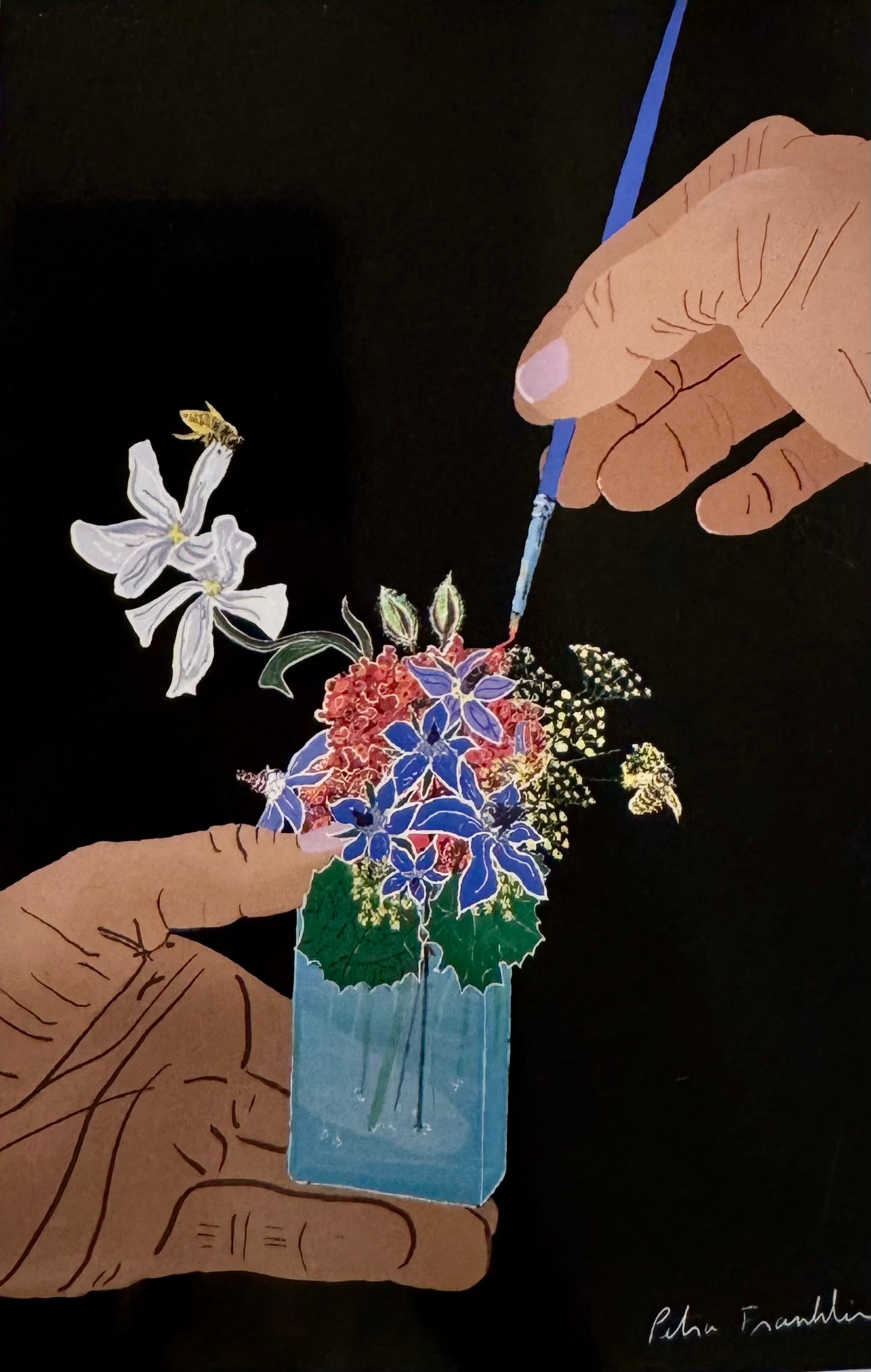
The painting today comes from Pollination and Propagation. I painted stems of Jasmine, Sorrel, Shiso, Verbena, and Fennel in a vase. All edible. There are three bees and adventurous roots growing on the stems, that need to be put into dirt.
ENDNOTES:
1. Khait, I., Lewin-Epstein, O., Sharon, R., Saban, K., Goldstein, R., Anikster, Y., Zeron, Y., Agassy, C., Nizan, S., Sharabi, G., Perelman, R., Boonman, A., Sade, N., Yovel, Y., & Hadany, L. (2023). Sounds emitted by plants under stress are airborne and informative. Cell, 186(7), 1328–1336.e10. https://doi.org/10.1016/j.cell.2023.03.009
2. Khait, I., Sharon, R., Yovel, Y., & Hadany, L. (2020). Plant-monitor. International patent application WO2020039434A1. https://patents.google.com/patent/WO2020039434A1/en
3. Hussain, M., Rahman, M. K. U., Mishra, R. C., & Van Der Straeten, D. (2023). Plants can talk: A new era in plant acoustics. Trends in Plant Science, 28(9), 987–990. https://doi.org/10.1016/j.tplants.2023.06.014
4. Son, J.-S., Jang, S., Mathevon, N., & Ryu, C.-M. (2024). Is plant acoustic communication fact or fiction? New Phytologist, 242(5), 1876–1880. https://doi.org/10.1111/nph.19648
5. Khait, I., Obolski, U., Yovel, Y., & Hadany, L. (2019). Sound perception in plants. Seminars in Cell & Developmental Biology, 92, 134–138. https://doi.org/10.1016/j.semcdb.2019.03.006
6. Ritchie, H. (2021, August 2). How much of the world’s food production is dependent on pollinators? Our World in Data. https://ourworldindata.org/pollinator-dependence
7. Hunting, E. R., O’Reilly, L. J., Harrison, R. G., Manser, K., England, S. J., Harris, B. H., & Robert, D. (2022). Observed electric charge of insect swarms and their contribution to atmospheric electricity. iScience, 25(11), 105241. https://doi.org/10.1016/j.isci.2022.105241
8. Clarke, D. J., Whitney, H. M., Sutton, G. P., & Robert, D. (2013). Detection and learning of floral electric fields by bumblebees. Science, 340(6128), 66–69. https://doi.org/10.1126/science.1230883
9. Bullinger, E., Greggers, U., & Menzel, R. (2023). Generalization of navigation memory in honeybees. Frontiers in Behavioral Neuroscience, 17, 1070957. https://doi.org/10.3389/fnbeh.2023.1070957
10. Dong, S., Lin, T., Nieh, J. C., & Tan, K. (2023). Social signal learning of the waggle dance in honey bees. Science, 379(6636), 1015–1018. https://doi.org/10.1126/science.ade1702
11. Dong, S., Lin, T., Nieh, J. C., & Tan, K. (2023). A Method for Studying Social Signal Learning of the Waggle Dance in Honey Bees. Bio-protocol, 13(16), e4789. https://doi.org/10.21769/BioProtoc.4789
12. Dunlap, A. S. (2024). Learning in the honey bee waggle dance. Learning & Behavior, 52(2), 133–134. https://doi.org/10.3758/s13420-023-00590-4
13. Giurfa, M., Giurfa de Brito, A., Giurfa de Brito, T., et al. (2021). Charles Henry Turner and the cognitive behavior of bees. Apidologie, 52(3), 684–695. https://doi.org/10.1007/s13592-021-00855-9
14. Zupanc, G. K. H. (2024). Ruth Beutler: the woman behind Karl von Frisch. Journal of Comparative Physiology A, 210(2), 167–188. https://pmc.ncbi.nlm.nih.gov/articles/PMC10995083/
15. von Frisch, K. (1962). Über die durch Licht bedingte «Missweisung» bei den Tänzen im Bienenstock [On the light-induced “deviation” in the dances in the beehive]. Experientia, 18, 49–53. https://doi.org/10.1007/BF02138246
16. Thom, C., Gilley, D. C., Hooper, J., & Esch, H. E. (2007). The scent of the waggle dance. PLoS Biology, 5(9), e228. https://doi.org/10.1371/journal.pbio.0050228
17. Habchi, C., & Jawed, M. (2022). Ballooning in spiders using multiple silk threads. Physical Review E, 105, 034401. https://doi.org/10.1103/PhysRevE.105.034401
18. Morley, E. L., & Robert, D. (2018). Electric Fields Elicit Ballooning in Spiders. Current Biology, 28(14), 2324–2330.e2. https://doi.org/10.1016/j.cub.2018.05.057
Delighted to read this journey in the natural world this morning Petra! Thank you for giving me a lovely curious reprieve from the distressing headlines. In the end, Mother Nature prevails and I love learning the fascinating info you tell so well!
Thank you, Petra.
You elegantly weave complex ideas and subjects with your art.
It’s a delight to read your posts; they have purpose and quietly teach.