
Heists and Backpacks
Operation Epic Fury and Other Revenue Streams

“American oil production is up by more than 600,000 barrels a day,” Trump told us in his State of the Union address, “and we just received from our new friend and partner Venezuela, more than 80 million barrels of oil.”
But “received” is doing a remarkable amount of work in that sentence.
Since December, U.S. forces have intercepted ten tankers and begun moving them through civil forfeiture, the legal process that allows the government to permanently seize a vessel and its cargo without compensation, when it alleges sanctions violations or smuggling. This is extraction dressed up as a procedure: a floating chokehold, enforced not with tariffs or treaties, but hands on, by dropping teams from helicopters or boarding vessels with court warrants.
This campaign is sprawling across sea lanes, the Caribbean into the Atlantic, Venezuela, Nigeria, with eyes now on Iran and the corridor that matters the most: the Strait of Hormuz. Reuters reports that roughly twenty ships have been identified as potential targets in 2026.
Money That is Disappearing
Civil forfeiture is designed to be traceable. Paperwork and escrow accounts. A vessel is intercepted. Cargo is seized. Oil is sold. The proceeds go into a public U.S. account: the Victims of State-Sponsored Terrorism Fund. That’s the deal. That’s the guardrail.
DOJ records show the Achilleas cargo sold for about $111 million; the Arina and Nostos together brought in roughly $51 million. The Suez Rajan’s 980,000 barrels sold for $74 million. But then, Semafor reported that proceeds from a Venezuelan oil sale, about $500 million, were routed into a private account in Qatar, instead of the terrorist victims fund. The same thing occurred with proceeds from numerous other vessels.
That gap is what Senator Elizabeth Warren is pointing to. “There is no basis in law,” she said, “for a president to set up an offshore account that he controls so that he can sell assets seized by the American military.”
The legal framework exists, she added. It simply wasn’t followed.
The seizures themselves have been increasingly overt. The Skipper was taken on the high seas in December 2025 with roughly 1.8 million barrels of Venezuelan crude as part of “Operation Souther Spear.” The DOJ has now filed to forfeit the vessel and its cargo. On January 7, 2026, U.S. forces boarded the Russian tanker Marinera near Iceland and the Panama-flagged M Sophia in the Caribbean. Eight more followed. “In past instances, mainly involving Iran,” former White House energy adviser Bob McNally noted, “the oil is sold and the U.S. government kept the proceeds. There’s a civil asset forfeiture process.”
Senators Ron Wyden, Elizabeth Warren, Chris Van Hollen, Andy Kim, and Elissa Slotkin are following these threads and bringing them to the Senate floor in a steady stream of resolutions.
Operation Epic Fury
On Friday, hours before the war began, the President was at a fundraiser podium in Corpus Christi, Texas, with Dennis Quaid and Ted Cruz, who posted photographs of the four of them on Air Force One.
Politico caught up with Trump after his speech and asked about Iran: “We’ve been playing with them for 47 years, and that’s a long time. They’ve been blowing the legs off our people, blowing their face off our people, the arms. They’ve been knocking out ships one by one. And every month, there’s something else, so… you can’t put up with it too long.”
After Texas, Trump headed to a MAGA dinner, one million dollars a plate, five million to be listed as co-host. From there, a black-tie party at Mar-a-Lago where he danced to YMCA and God Bless the USA in the glitzy ballroom. Then, finally, his Miami war room, where he recorded his address to the nation: “The lives of courageous American heroes may be lost,” he said. “And we may have casualties. That often happens in war.”
He posted it at 3:45 AM ET on Saturday morning, after the attacks had begun.
America woke to the news that a girls' school, Shajarah Tayyiba, in Minab, in the Hormozgan province, had been bombed. 153 students were killed. By the end of the day, there were 201 Iranian deaths due to air strikes and 747 reported as injured.
Later that day, the President confirmed the death of Supreme Leader Ali Khamenei and much of his cabinet. In recorded remarks, he addressed Iranians directly, as though he were already their head of state. “Now you ‘have a president’ who is giving you what you want,” he said. “So let’s see how you respond.”
Late Saturday night, Trump posted to Truth Social that "Iran just stated that they are going to hit very hard today, harder than they have ever hit before." By the following morning, three United States soldiers were dead.
In parallel, legislators were on the phone, grappling with the fact that the executive branch had, again, committed the U.S. military to war without them. Sen. Thom Tillis of North Carolina, a retiring Republican, was among those who went on record, saying he expected “all members of Congress will soon be briefed about Operation Epic Fury and determine whether a broader scope and further military action requires an authorization by Congress.”
The Real Deal
What Trump Wants From Iran
Oman’s mediator, Badr Albusaidi, put the nuclear terms in public: Iran would agree to zero stockpiling of enriched uranium, with full IAEA verification. “If you cannot stockpile material that is enriched,” he said, “then there is no way you can actually create a bomb.”
But nuclear disarmament was only the wrapper. Jared Kushner warned his father-in-law that a “good deal” with Ali Khamenei was “difficult, if not impossible.” And if a deal were signed, Iran was unlikely to honor it.
The bargaining went well beyond uranium. On February 15, Iran’s deputy minister for economic diplomacy, Hamid Ghanbari, expanded the goods, "shared interests in the fields of oil and gas, joint fields, mining investments, and even aircraft purchases have been included in the text of the negotiations."
The template was already visible in Venezuela. There, the deal was straightforward: the U.S. military seizes your oil, you receive a percentage of proceeds, and the rest disappears into accounts without oversight, exactly the offshore structure Senator Warren has said has no basis in law. Trump has said, more than once, that he enjoys "running" Venezuela. Pete Hegseth is ready to deploy the military as an extraction mechanism. When the keys to Iran were not handed over, when Jared Kushner and Steve Witkoff, negotiating on behalf of the United States and Iran's neighboring governments, couldn't close the deal, the next move was to remove the regime and install one that would.
Along Iran’s coast lies the Strait of Hormuz, one of the world’s great energy arteries, through which at least a fifth of everything the world burns passes annually. The country holds 68 types of minerals, with proven reserves valued, in 2014 figures, at $770 billion. It reads like a shopping list for a superpower. Iran atop the world’s largest zinc deposits and the second-largest copper lode. Its Hamadan Province holds 8.5 million tons of lithium-rich clay, placing it among the world’s most significant reserves of the metal that will power the coming century’s economy. And Iran is a top producer of antimony, a mineral the U.S. Department of Defense uses in over 200 ammunition applications, from detonators to armor-piercing rounds. China banned all antimony exports to the United States in December. Prices rose 350 percent in a year.
This war is not about preventing nuclear armament. It is about claiming a periodic table. And the oil. And the gas.
What the Iranians Were Enduring
The war landed on a population already in open revolt.
In the three months before the bombs fell, Iranians had been in the streets in significant numbers and too many died there. They were not protesting nuclear policy or American sanctions, they were demanding an ordinary life. The cost of cooking oil. The price of red meat. The gap between what the Islamic Republic demanded of its people and what it was willing to give them in return.
Mohammad Machine-Chian, a senior journalist at Iran International and former researcher at the University of Pittsburgh, framed the unrest as something deeper than economic frustration. “Demanding a normal material life is in and of itself a rejection of Khomeinism,” he explained. The Khomeinism ideology prescribes sacrifice for the state as a religious obligation. To want a decent meal is, in Iran, a political act.
The numbers he cited are not abstractions. Inflation running at nearly 60 percent. Food inflation at 72percent. Cooking oil up 200 percent. Red meat doubled. “If we go deeper,” he said, “it gets uglier.”
The institutions that once absorbed this kind of pressure, that gave the Islamic Republic its social legitimacy, are gone. The historic alliance between the bazaar and the mosque, the twin pillars of the state’s civic life, has fractured. “The bazaar is finally breaking completely with the Islamic Republic,” Machine-Chian said. As for the mosques: “They now have detention centers. They no longer serve a social or civil purpose in Iranian society.”
Mosques as detention centers. The state’s sacred spaces repurposed for punishment.
That image is uncomfortably familiar. We have watched churches approached as sites of immigration enforcement, public institutions hollowed of their civic function, the vocabulary of faith weaponized in service of the state.
The Islamic Republic and the MAGA movement are not the same thing. But there are streets people avoid for fear of government enforcement. There are families separated without process. Detention centers. These are not foreign phenomena observed from a distance. They are happening here, and they are happening there, and the people engineering them in both places know exactly what they are doing.
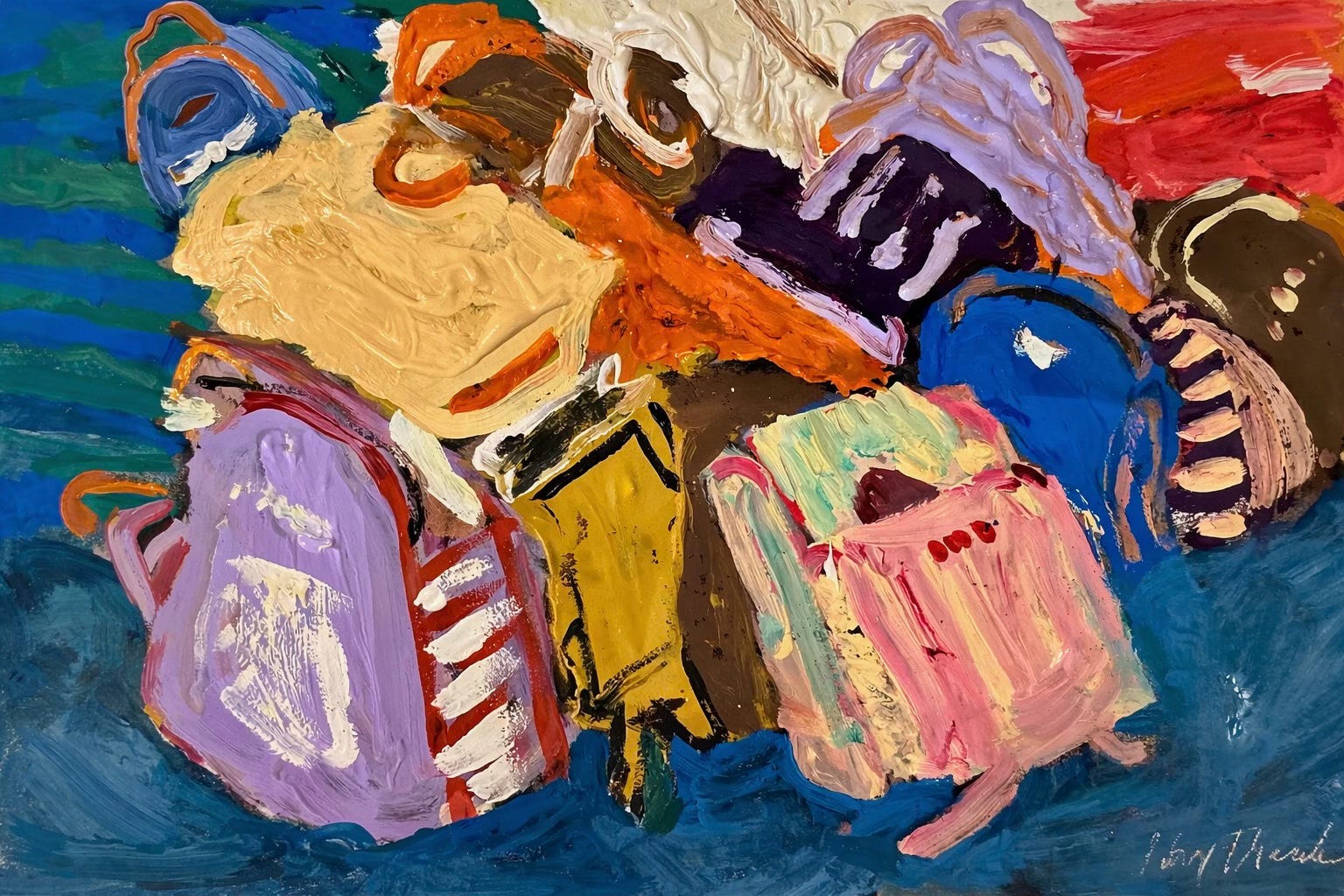
The Iranian people were already fighting for a normal life when we began bombing them. That they are now expected to bear the violence of this “regime” change, with their lives, their schools, their children’s backpacks, is the context the war coverage keeps leaving out.
Trump is a Catalyst of Radicalization
Trump’s aggressive, acquisitive approach to foreign policy is an American liability.
When the girls’ school in Minab was hit, Shajarah Tayyiba, in the Hormozgan province, the bomb did not land only on those 150 children. It landed on every sibling, parent, grandparent, and neighbor who will carry that day for the rest of their lives. You do not recover from losing a child. And their communities, the historical record tells us, will not either.
National security researchers have documented what they call the radicalization cycle: the death of a child at the hands of a foreign military is among the most potent known catalysts for the kind of grievance that transcends decades, crosses borders, and becomes the emotional inheritance of the next generation. The attacks of September 11, 2001 did not arrive from nowhere. They were born in the accumulated fury of people who had watched foreign militaries act with impunity in their homelands, on their families, across generations.
Grief of this magnitude does not expire.
I’m off to check out the telescopes tonight! Can’t wait to see Jupiter: 444 million miles away and the Orion Nebula: 1,300 to 1,500 light years away. Thus I am seeing Orion Nebula as it was 1,300 to 1,500 years ago, and perhaps it is feeling quite different now.
Thank you Noah (Volunteer park Telescopes) for bringing us out to gaze up.

Photo from Miquel Claro based in Lisbon, Portugal.
I couldn’t do this without you. I am incredibly grateful that you are curious!
~ Petra