
Subtle Retrieval
What happened in the mountains, how leaders reach their citizens, a crypto-almost reveal, and a fraying ceasefire.

Ejection in the Zagros Mountains
A U.S. Air Force colonel, call sign DUDE44 Bravo, was blasted out of an F-15E Strike Eagle over the Zagros Mountains on the morning of April 3. Ejection is no graceful escape. A rocket fires beneath the seat and hurls the body out of a crashing aircraft with such violence that often it costs them a couple of inches.
For fifty hours after that, DUDE44 Bravo was a bloody mess wedging his broken frame into crevices in the mysterious salt domes, scaling cliffs by touch, staying in the shadows, while he watched the Islamic Revolutionary Guard Corps fan out far below.
In Washington, the President watched his heat signature, a lone pulse against a mountain of enemies, from the Situation Room, as the loudest “rescue” in military history took place.
To extract one man, Hegseth launched his fever dream: 155 aircraft, a vast diversion, and a rescue operation so outsized it seemed designed for television as much as survival. The force he was using bore the imprint of Operation Eagle Claw, the failed 1980 U.S. hostage-rescue mission in Iran, which ended in catastrophe at Desert One and killed eight American servicemembers. Its wreckage exposed deep flaws in joint planning, aviation coordination, and command, and the reforms that followed built the modern special-operations team that made this successful rescue, for all its chaos and excess, even possible.
Seven fake convoys were ordered to distract Iranian sensors and lead them towards the Afghan border, while two MC-130J Commando II special operations cargo planes landed on a farm, ramps dropping before the wheels had a chance to stop spinning, to unload the cargo of three MH-6 Little Bird helicopters that had been disassembled.
In the dark, teams worked with practiced urgency, bolting the Little Birds back together by flashlight. The helicopters flew seven minutes to the ridgeline. Seven minutes back. The colonel was out.
Then, an inconvenient mishap: the heavy cargo planes got “stuck” in the mud. The most elite special ops aviation unit in the world called for backup and while they waited, they set devices to blow up the place—Little Birds and all—as they lifted off, indeed it lit up the sky, leaving a charred graveyard for Iranian cameras.
It was a swell movie ending for a leave-no-man-behind story.
And a story it likely was. Not much holds up.
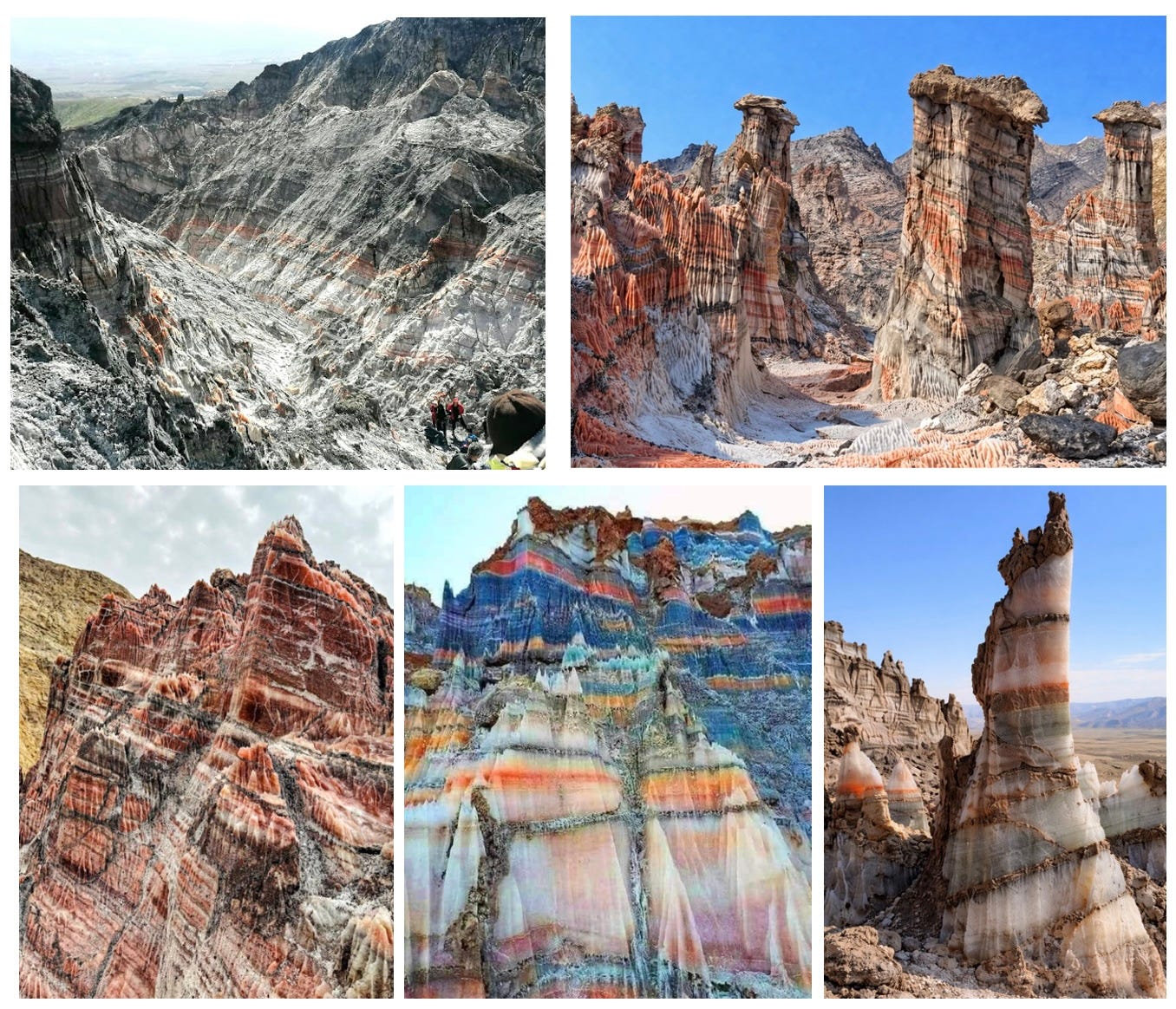
Not Much Holds Up
The colonel was recovered more than 100 miles from where the pilot was retrieved, suggesting he may have ejected earlier. He was potentially climbing near the “hatch door” of Iran’s largest cache of enriched uranium, in a mountainous region near the Isfahan Nuclear Technology Center. If he had been lost, normally a standard helicopter with a hoist would have been used to retrieve him.

Certainly not a theater-wide combined-arms operation of 155 aircraft, four bombers, sixty-four fighters, forty-eight refueling tankers, thirteen rescue aircraft, MC-130J special operations transports carrying disassembled assault helicopters, CIA covert action authorities, seven simultaneous feints across the country, and two B-2s striking underground targets near the capital.
CBS News reported that other planned military operations were halted as “U.S. military power and the president’s attention pivoted to the combat rescue mission.” For one injured weapons systems officer, the entire war stopped.
What the Bombs Missed
In June 2025, the United States launched Operation Midnight Hammer. Six B-2 Spirit bombers flew nonstop from Whiteman Air Force Base in Missouri and dropped a new munition called a GBU-57 Massive Ordnance Penetrators on three Iranian nuclear sites: Fordow, Natanz, and Isfahan. It was the first combat use of the weapon in history. Tomahawk cruise missiles followed just to be sure.
The Pentagon said Iran’s nuclear program had been set back by years.
But there was a problem the bombs could not solve. Iran had seen it coming.
Satellite imagery from June 9, 2025, shows a flatbed truck loaded with eighteen blue containers parked in front of the south tunnel entrance at the Isfahan underground complex. Analysts assessed that the containers held highly enriched uranium and that Iran had moved its most valuable nuclear material into well-protected hardened tunnels before the first bomb fell.
The enrichment infrastructure was destroyed, the centrifuges were reduced to rubble, but approximately 440 kilograms of uranium enriched to 60 percent remained intact and was dispersed across three underground storage tunnel systems near the nuclear facilities at Isfahan, Natanz, and Fordow.
A Very Narrow Access Point
Iran appeared to preempt us again this February, collapsing the entrances to their tunnel system and entombing the uranium to protect it from further attack.
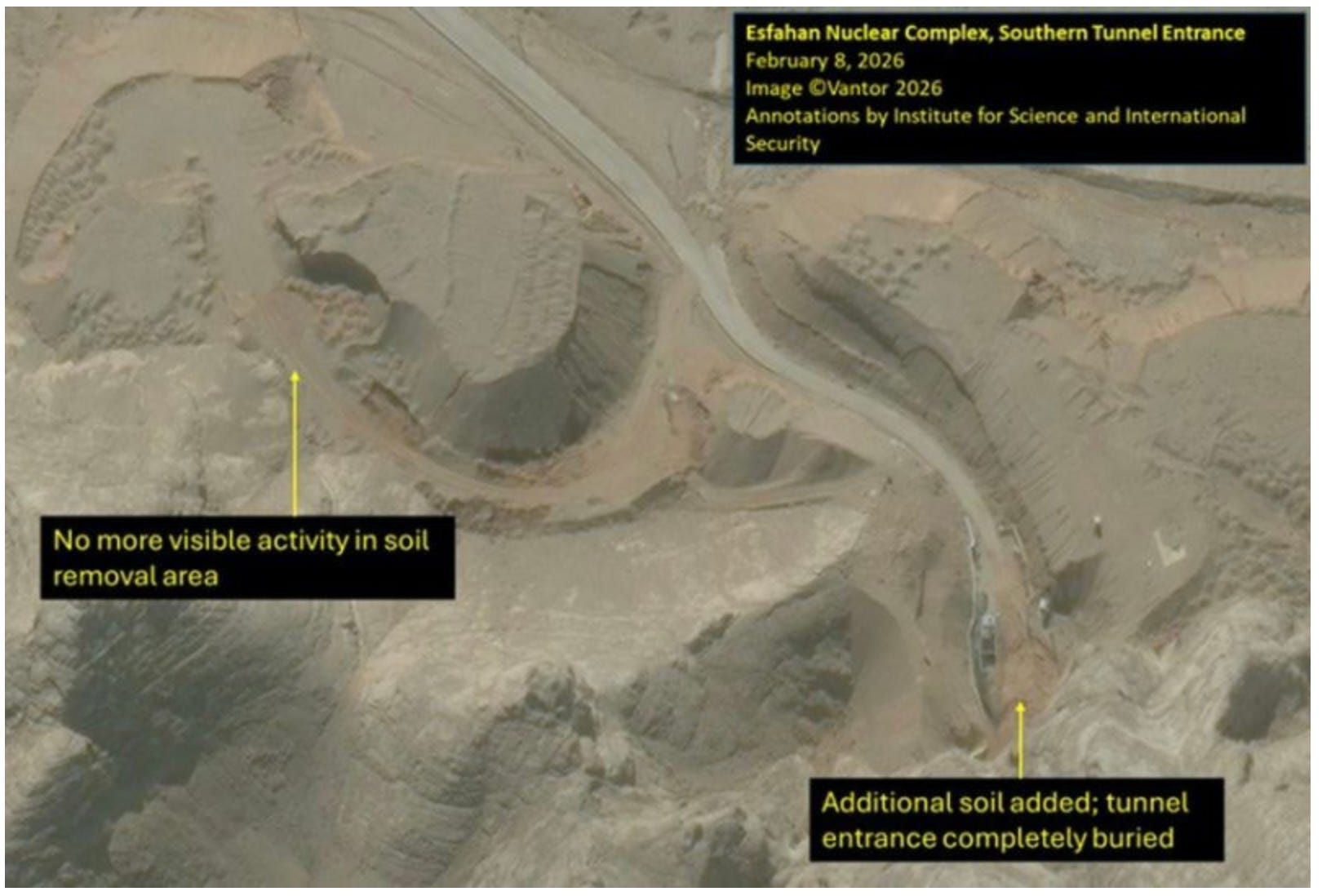
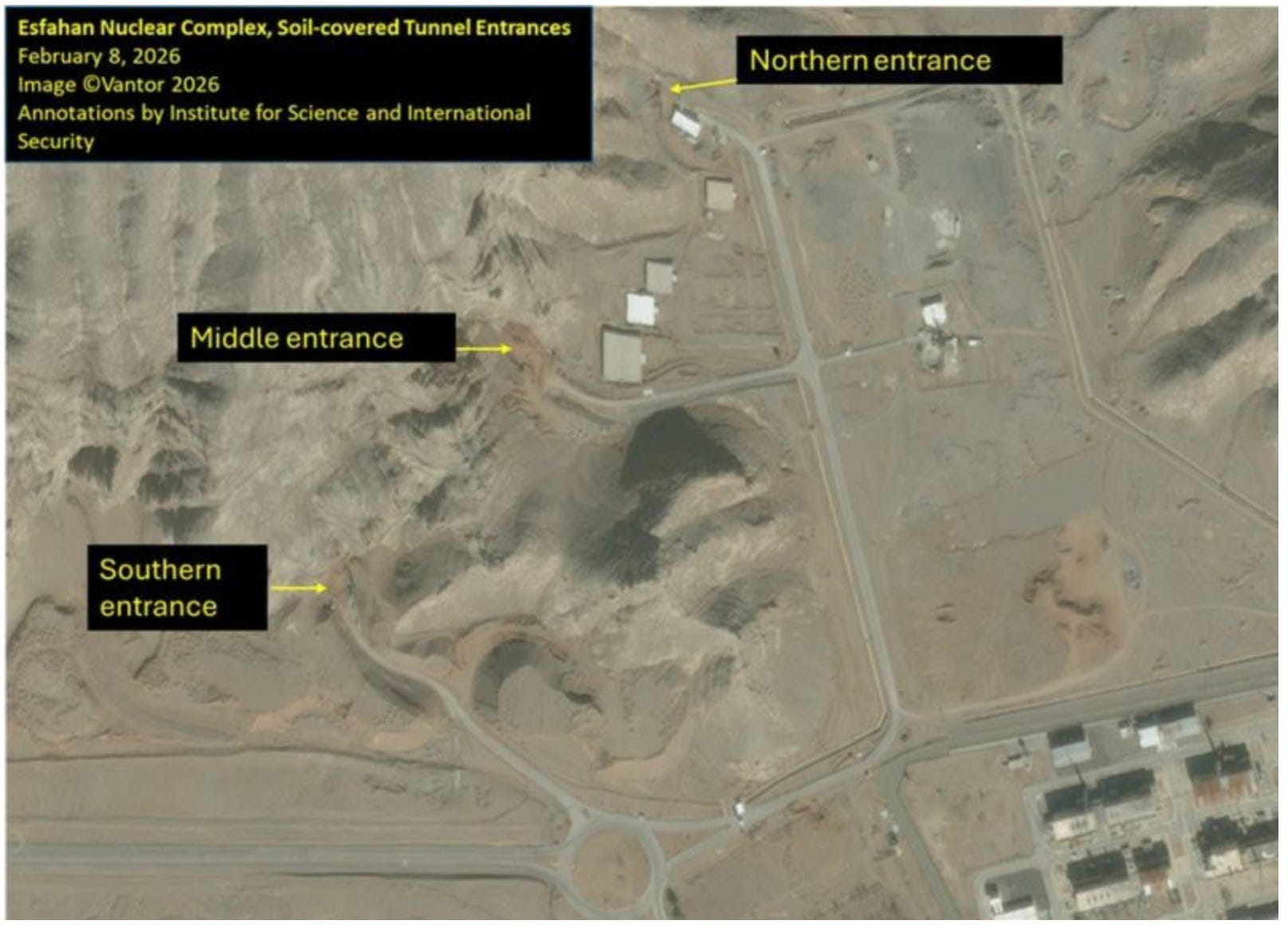
In March, The New York Times reported that U.S. intelligence agencies had concluded Iran could still retrieve the material through “a very narrow access point.” The Wall Street Journal reported that President Trump was weighing plans to send troops to seize it. Retired NATO commander James Stavridis told the Journal that, if such a mission were possible, it could require “the largest special forces operation in history.”
Were the 82nd Airborne and the two Marine Expeditionary Units really there for a missing colonel? Or were they the muscle behind a nuclear snatch operation dressed up as a rescue?
Little Birds are built for assault and reconnaissance, operated by the most elite special operations aviation unit in the world. They are not standard rescue helicopters, which is one reason this operation reads as a highly targeted “insertion” campaign.
Then, on April 3, an F-15E Strike Eagle was shot down. Perhaps that is true. But why was it flying in an area heavily guarded by the Islamic Revolutionary Guard Corps? Had it already dropped DUDE44 Bravo when it took fire?
While the colonel scaled the ridge, Iranian state media was broadcasting “Tabas II,” a propaganda Lego video mocking what they believed was an American uranium extraction mission by showing U.S. helicopters swallowed by the same desert sands that claimed Operation Eagle Claw in 1980. To Tehran, the mission was a divinely scripted failure in the making. To Anthony Aguilar, the former special forces soldier whose leaks had already begun peeling back the administration’s “heroic” veneer, it was the first layer of a state-sponsored fiction.
An expert in Middle East strategy, Dr. Arash Reisinezhad, noted that the recent dismissal of top American generals, including Army Chief of Staff Gen. Randy George, “may not be coincidental,” suggesting internal resistance to operations of this risk profile. In normal circumstances, the Army chief of staff would be among the senior leaders weighing whether to authorize a special forces operation this deep inside enemy territory.
The material sat in the dark, accessible through a secret door in the folds of the mountain, waiting for a skilled team to reach it.
Enriched uranium represents capability. Four companies over seven countries control the commercial uranium enrichment market: Russia(40%), China(17%), United States(12%), France(12%), Netherlands(8%), United Kingdom(7%), and the Germany(6%). Iran was building toward becoming the eighth. Not necessarily to sell bombs, or even to build them, but to sell fuel: low-enriched uranium for the 440-plus nuclear reactors operating worldwide; high-assay low-enriched uranium for the next generation of small modular reactors that countries building AI-hungry data centers may soon need; medical isotopes for cancer diagnostics; and naval propulsion fuel.
The global nuclear fuel market is already worth tens of billions of dollars a year, and it is poised to grow much larger. Major economies are pivoting back toward nuclear power to meet rising electricity demand from artificial intelligence infrastructure. The United States is scrambling to build domestic enrichment capacity and reduce its dependence on Russia. Long-term uranium contract prices have climbed to $90 per pound, their highest level ever, while utilities face record volumes of “uncovered requirements,” future demand not yet secured by contract.
It is possible that all of this is coincidence. That the largest, most expensive, most operationally complex combat rescue since Desert One just happened to put a special operations task force on the ground within miles of Iran’s enriched uranium stockpile, and that nobody in the chain of command thought to take a look while they were there.
The Pentagon says the MC-130s got stuck. Anthony Aguilar, a retired U.S. Army lieutenant colonel and former Green Beret, says that does not hold up. He has seen MC-130Js operate through dirt, mud, snow, and gravel; sand alone would not strand them. The more likely explanation, he suggested, was that the aircraft took hits on entry and while on the ground at that hastily established refueling point. If Aguilar is right, the operation likely went wrong in ways we still have not been told.
The Story Iran Knows
The Iranians believe they know exactly what happened. In a Lego-style propaganda video titled Uranium Heist in the Dead of Night, they cast the mission as a botched American extraction attempt. The video mocks the operation as a second Tabas, invoking the 1980 Desert One disaster: the same overreach, the same hubris, the same wreckage in the sand. The videos are propaganda, but their central claim has been strikingly consistent — and uncomfortably close to the shape of the evidence.
Two Iranian Lego propaganda videos from the Persia-Boi team.
Billboards and Truth Social
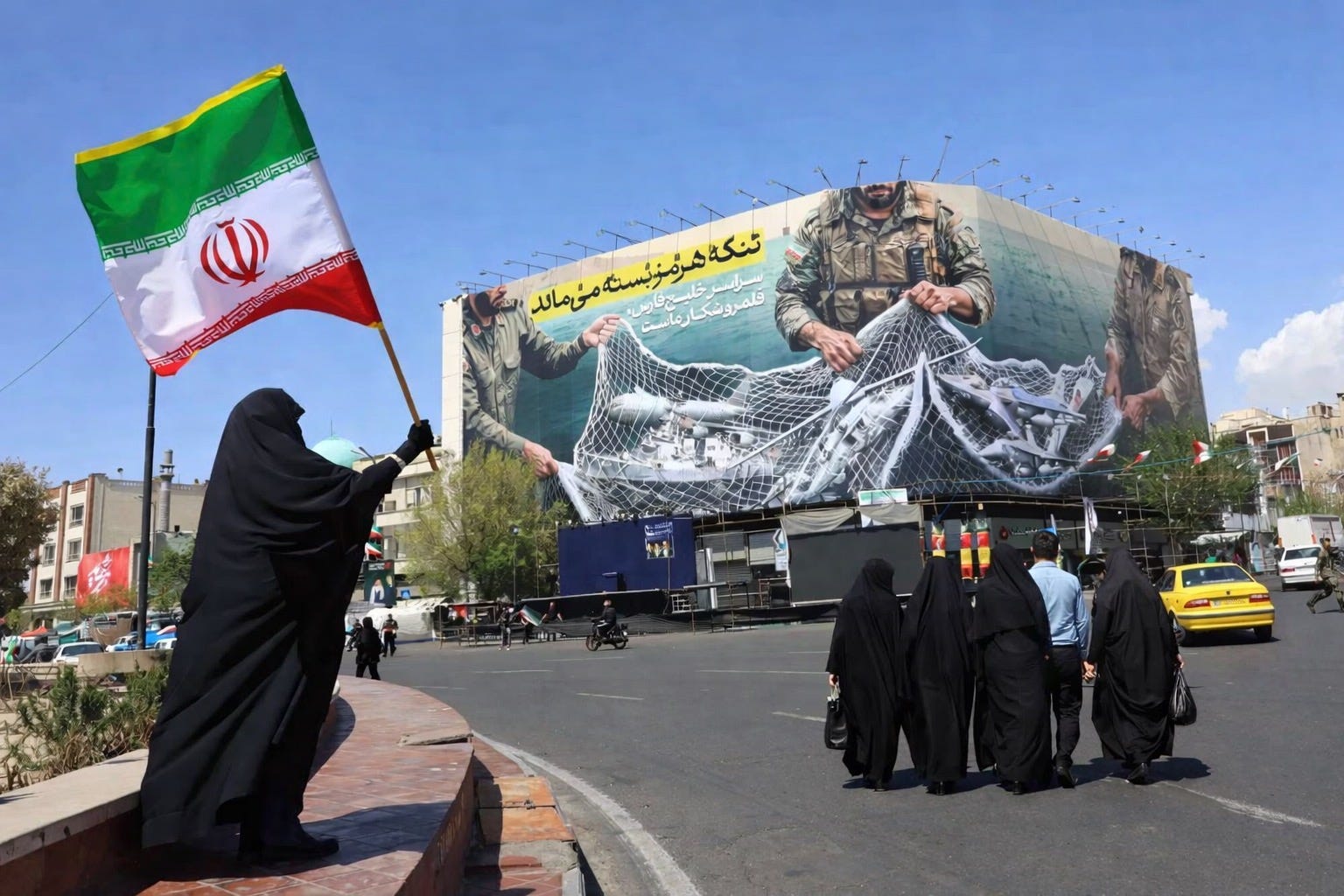
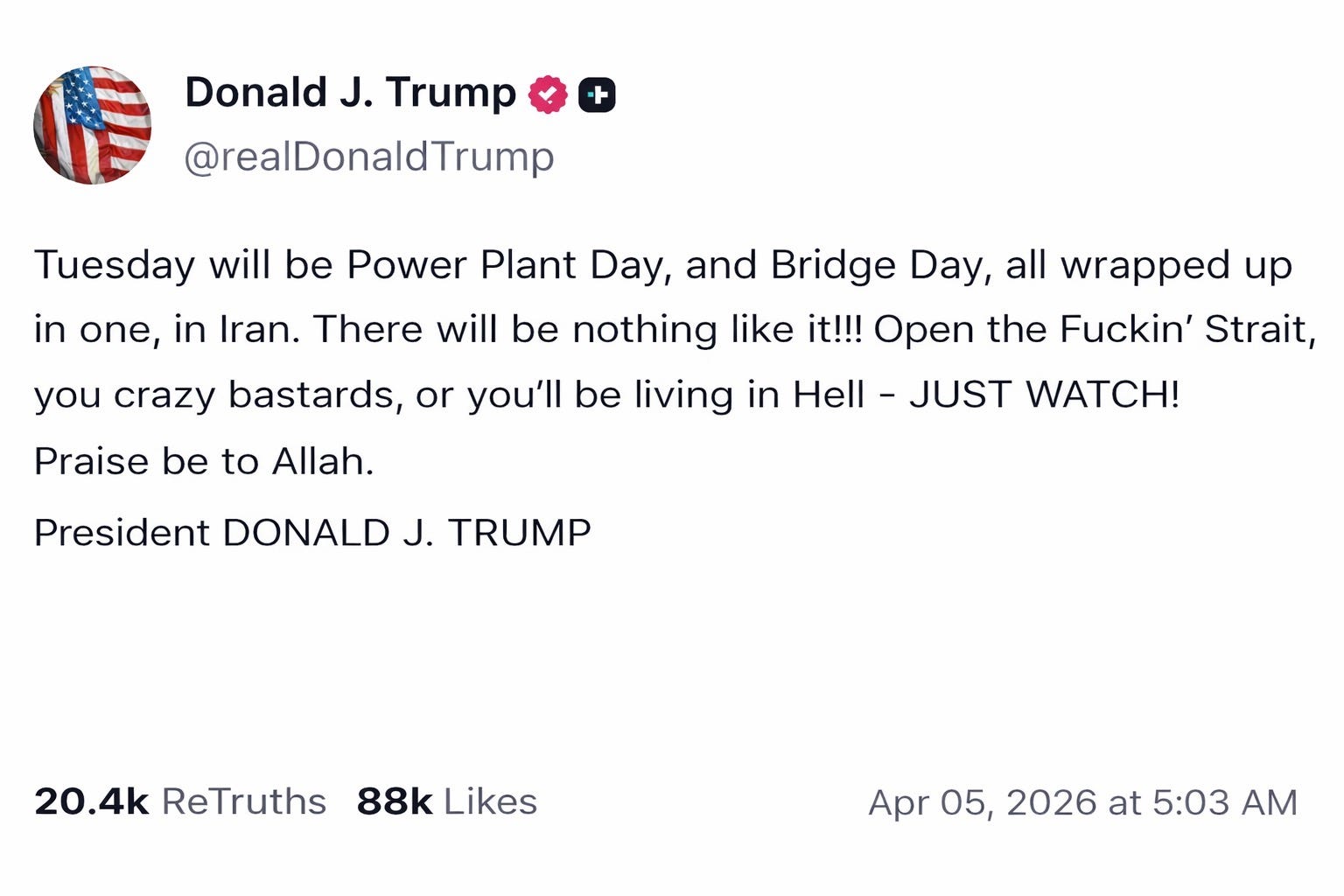
In the United States, our President communicates via Truth Social posts. Iranian citizens hear from their leadership via giant billboards. The mural below was posted in Enghelab Square in Tehran on April 6, 2026 in response to Trump’s post below. I think it is interesting that the heads of the soldiers are missing and that the net is full of U.S. jets and ships instead of fish. It captures the new found power Iran holds over the strait and seems to say: the strait is staying shut, and if the U.S. presses its luck in the Gulf, it too will become our prey.
The Creator of Bitcoin is Sort Of Discovered
John Carreyrou, the two-time Pulitzer Prize-winning New York Times reporter who famously exposed Theranos, recently turned his attention to the mystery of Satoshi Nakamoto. After years of tracking, he has identified cryptographer Adam Back as the likely creator of Bitcoin, and the long-anonymous Satoshi Nakamoto. This was based on extensive linguistic and historical analysis of early writings. Back publicly denies the claim, arguing the evidence is circumstantial.
Adam Back also explains that Bitcoin’s anonymity is part of its strength and that if he were Satoshi, he would have powerful incentives not to admit it, especially as he prepares to take a company called BSTR public. If he were to reveal ownership of the estimated $70+ billion in Bitcoin attributed to Satoshi, that would trigger major disclosure requirements and potentially jeopardize the company’s previous filings and valuation.
The Fiery Ceasefire and the Courtroom
Today, Israel attacked Iran-backed Hezbollah in Lebanon. PBS News reported that the intense strikes killed 300 civilians and injured 1,000. Hezbollah continued to strike back with rocket fire in northern Israel. Iran did not honor the ceasefire either. It bombed a crucial Saudi Arabian oil pipeline and a National Guard facility in Kuwait. You could count on one hand the number of tankers that paid the expensive $2 million toll to pass through the strait.
Iran says that Lebanon is part of the ceasefire. President Trump and Prime Minister Netanyahu say they did not believe Lebanon was mentioned in the agreement. It is important to note that the Israeli prime minister is scheduled to return to his long-running corruption trial on Sunday, April 12, 2026. It was paused during the Israel-Iran-Lebanon conflict. Netanyahu faces serious charges of bribery, fraud, and breach of trust in three separate cases. Trump, always quick to do whatever the prime minister asks, pleaded with the Israeli president to pardon Netanyahu, but the president responded that the court had jurisdiction and that he did not want to interfere.
Heather Cox Richardson said today that when this is over, we do not need to completely rewrite our constitution and bill of rights; we simply need to enforce it. That is one reason this trial captures my attention.
We desperately need our trials in the United States to not be delayed, thrown out, or verdicts ignored. I hope Netanyahu’s trial resumes. I felt something similar watching South Korea reject the martial law declaration on December 3, 2024. Watching democracies recover is sexy and the suspense of this particular one is intense. Will this prime minister be held accountable?
Democracy rests on the principle that people must be able to speak truth to power, hold it accountable, and replace those who wield it. It protects individual dignity and the freedoms to speak, publish, worship, organize, and assemble. It also protects the rights to a fair and impartial trial and to equal treatment under the law. Only democracy is built to protect those rights, because it places sovereignty in the people rather than in a self-appointed few. Liberty and democracy rise or fall together.
Our rights rely on fortifying our rule of law, ensuring it is applied equally and that it protects everyone.

Thank you for being here.
Yes that is a cloudless blue sky. We’ve had a string of gloriously sunny days and the park has been lively in the early evenings. Volleyball games, Cello players, lots of picnic blankets and kids.
I am grateful tonight. Grateful to be able to write, grateful to you wise readers, and grateful to those of you who make this work possible. As winter thaws into spring, the red crabapple flowers open, the beaches bend with their colorful weight, and I feel too feel renewed.
Parks are outdoor cathedrals for cities.
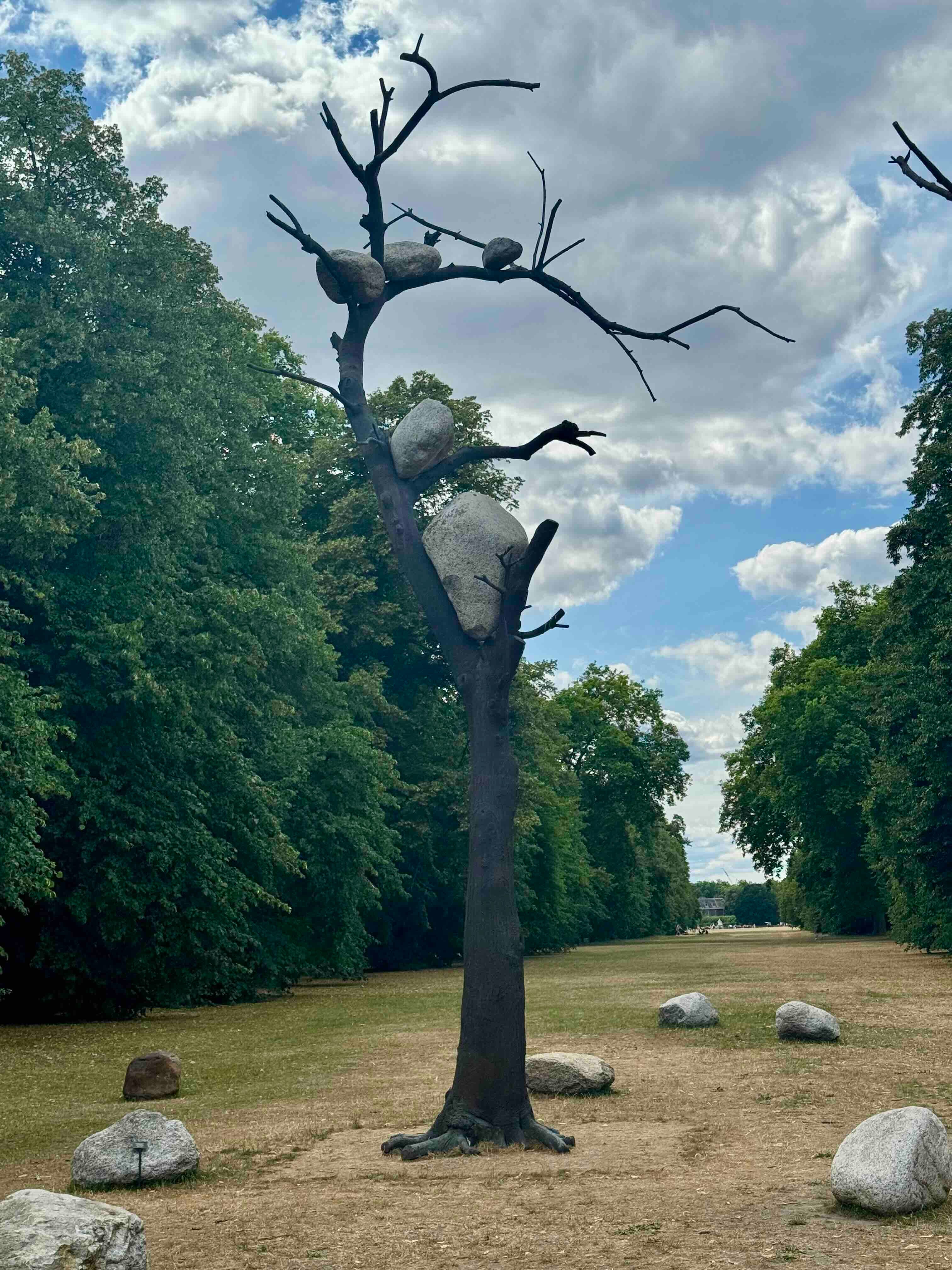
This is a work by the sculptor Giuseppe Penone located in Kensington Garden.
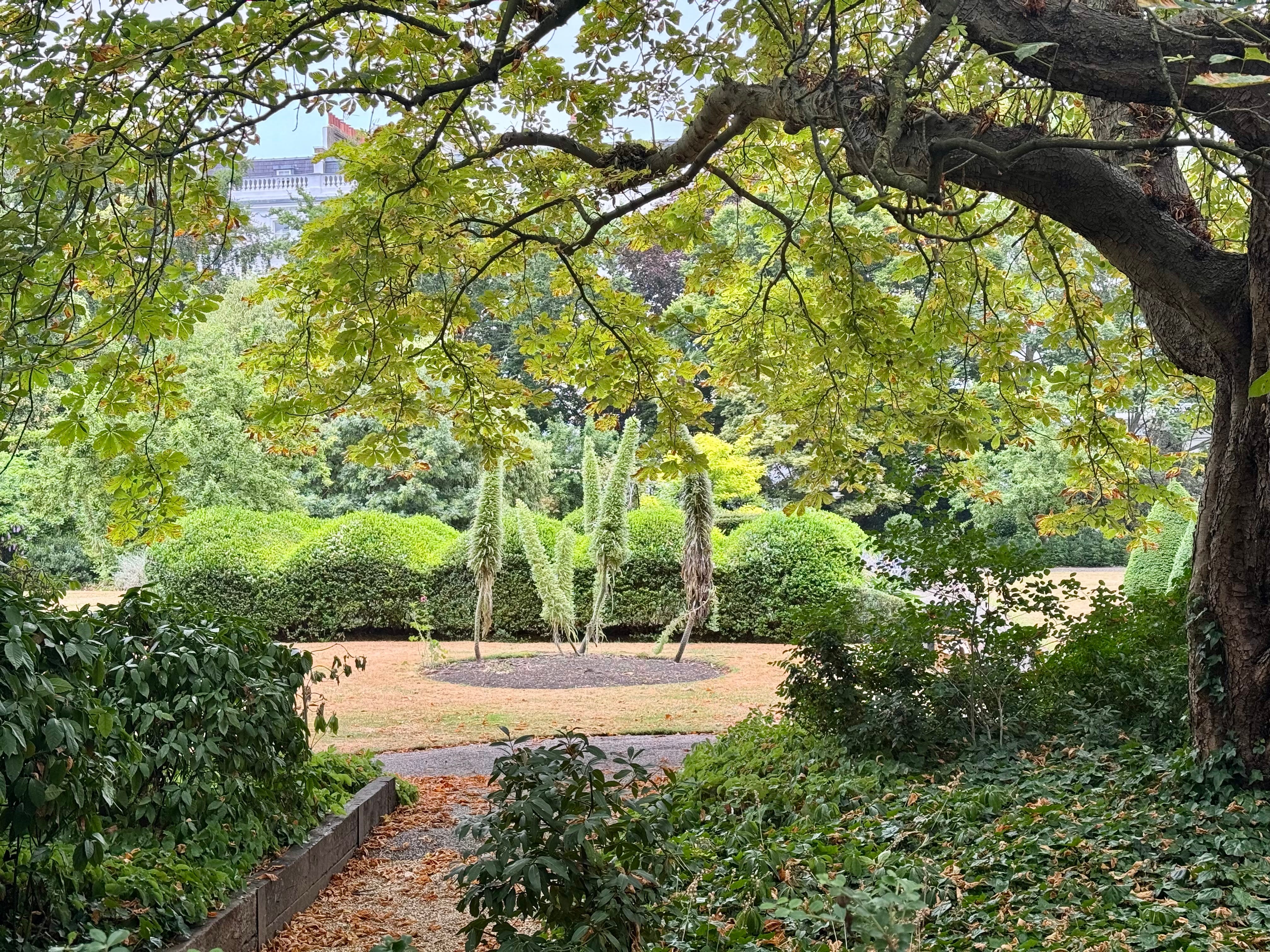
This is Cadogan Place Gardens in London.

Peaking in on oversize Chess games in Portman Square
Riveting read. Thank you.
How do we know "The colonel was recovered more than 100 miles from where the pilot was retrieved"? I've been unable to find a description of where the pilot was extracted.